‘liberty or death’ author’s note

liberty or death

The first stanza was written while I was angry with my parents for not allowing me to go out with friends or to have privacy under the pretense that it was to “protect me.” Hence why they’re swaddling me like a baby but it’s eventually going to suffocate me, killing my soul or preventing my growth and maturity. This made me realize that there are some parallels that run with how they’ve raised me so far and the not-so-good romantic relationships my friends have been in.

The next two stanzas are pretty self explanatory.

The third one has a lot of weight for myself. A fond gaze can mean a lot of different things to me. It can mean one of exasperation but simultaneously endeared or one full of adoration or one with reverence and awe. Even just a single look can mean everything to me because I can read people through their eyes, even if they don’t wear their hearts on their sleeves.

The next stanza is about mutual respect — acknowledging each other’s strengths and working together to train those weaknesses — somewhat, but it’s also about the situations I often find myself in. I’m a bit of a people pleaser. As much as I pride myself in being able to read others well and get along with them, it’s sometimes because I have the tendency to bend myself forwards and back, trying to appear likable. That’s why having this blog is so important to me. It’s where I can be raw, scathing, and cruel if need be because this is all me and who I am.

Does this mean I’m a pushover? Maybe. The rare types, to be frank. The extrovert who has no problem saying “no” but at the same time, struggles to say “no.” A living paradox. But all of that also stems from my vision of humanity and my ability to see the good in people, give them the benefit of the doubt. My mother has said it’s a naïve way of thinking, and she may be right. (But sometimes, I think it’s because of the way she raised me in those thick blankets of bubble wrap.)

What’s also funny is that I used to be a hardass, a dictator-ish person when I was younger. But I grew too soft because that wasn’t an effective way to lead or become close to people. Two extremes and I’m in a desperate race to get into equilibrium before I go off to college so I don’t get swindled or something, haha.

I digress. The title is from Metallica’s “Don’t Tread on Me.” I wouldn’t say it’s entirely fitting, given Metallica’s genre of music but I really like their music so “liberty or death” it is!!

‘state of limbo’ author’s note

state of limbo

This poem was written for day two of Escapril, where the original post can be found here. The prompt called for “the exact middle,” which I honestly had no problem writing about. I am in a stage of my own life where I am in the “exact middle” but also in a “state of limbo.” The awkward halfway point between childhood and adulthood: Being treated like a child by assuming we aren’t autonomous, while simultaneously expecting the same amount of effort and responsibilities as adults, if not more.

I have been struggling with identity, even more so during quarantine as I have had more time to myself to think about everything and anything. To be frank, it’s less about my Asian-American status and more about my role in society; my hopes and dreams; my sexuality and gender; and what kind of soul I have deep down. Call it teen angst, but it does, indeed, have a body count: Myself.

Well, my younger self.

I digress: The left-aligned lines represent the happier times I spent — in hindsight — when I was younger. This includes even just sophomore year. I say “hindsight” because I revisited my diary to see that the things that felt like such a big deal to me back then is very minuscule compared to the mounting pressure I have on myself and from my family at the moment. (I’m sure in the future, I’d say the same thing now. How everything was so trivial, not worthy of the stress and worry I’m putting myself through.) With the knowledge of the regrets of what I did and didn’t do (something that deserves its own post) and the promise of better days, I find myself wishing to go back in time.

In the poem, I cut myself off before I can utter those words even in passing. For me, whenever I speak my thoughts into existence by writing or speaking them out loud, they feel so final, so binding. It solidifies how I’m feeling into a fact that will stubbornly not budge until I waste spend an entire day reconsidering how I’m feeling.

The right-aligned lines are the hopes and fears I have as I approach adulthood and eventually leaving my parents and home. Without exposing too much about myself because I’m already feeling uber vulnerable writing about my thought processes, I’m unhappy with how my parents are treating me at home (let’s just leave it at that…). I understand that all of my problems won’t be fixed as soon as I leave home but it’s the only thing that’s keeping me going — my hope. But there’s still that innate fear that I would have to crawl back home because I couldn’t handle the heat of independence and society, much like what my mother has conditioned me to think (despite knowing that I would thrive) — my fear.

Despite the anxiety that something may go terribly wrong, I would much rather see myself shrug off the childishness of childhood and awkwardness of teenhood and go straight to adulthood with all of its beautiful promises of autonomy, independence, and choice.

The last stanza repeats the first, because no matter what I beg for, I’m stuck in my seventeen-year-old body, all awkward and clumsy with the remnants of the chub from my childhood and body of a full-grown adult after puberty. And the best thing I can do is live in the moment so I don’t have any more regrets, work towards making those hopes a reality, and nip those fears right at the bud.

In the exact middle. Yup, that’s where I, Kae S., am in.

I hope this poem was somewhat relatable (for my teenage readers) or reminded of the teenage awkwardness you left behind (to my adult readers). Thank you for reading, and I’ll see you at the next poem!

‘(to be) freed’ author’s note

(to be) freed

I posted this piece on Instagram for Escapril 2021. Like the caption says, I debated on whether or not to participate because I’m not much of a poet. I think that was the first time in about three years I wrote a poem and the first time I wrote a poem that wasn’t for a school assignment ever. After this piece, however, I took a liking to poetry because of how I can create a narrative with even the structure alone.

The Instagram post does a better job of showing how I tried to visually tell the story of the speaker but WordPress ultimately failed me, haha. I’ll probably go back to the original post and try to edit the code to show up the way I want it to. (Pain.)

I dedicate this poem to my tenth grade English teacher. She’s probably my favorite English teacher that I’ve had so far. She didn’t know my love for creative writing because I still had a fat writers’ block back then but she always gave constructive criticism that encouraged me to do better on all my essays. We’re extremely close, and I’m always thankful that I have a trusted adult at school I can talk to.

She had such creative lesson plans that made my first 7 AM class in the morning so interesting (when otherwise I would slowly nod to sleep). One project that really stuck out to me was the Creative Lens project we had to do. We take well-known fairy tales and analyze them using different narrative lens she gave lectures on. Some of them had to do with political theory, some with history. That made me develop my love for analyzing text.

A lens that I used in this poem that I first learned about then was the Freudian lens. They include the id, superego, and ego. I’ll try to keep this psychology lesson short but from what I remember and understand, id represents our primal desires and impulses that are actively squashed by our superego, which is the epitome of morals and ethical values. As these two fight to manifest outwardly, your ego determines which side to give into slightly. Thus your ego is what you present to society and keeps these other identities in check with rationality.

As quarantine starts to drag longer and longer, I found myself expressing my anger and grief more often in my writing and thoughts. This is my id, not to mention the seething reactions to my parents’ behaviors (something I’m a bit uncomfortable sharing as of now).

This poem was written as a reminder to my future self of what I had to go through during COVID. The stir-craziness of constantly staying indoors, the mounting frustration as my parents start to influence and control my actions, and the self-doubt that plagued my mind due to various reasons and began to negatively influence my work.

Id and superego are silent at the end because they’re ruminating the confident declaration ego made. It’s a pregnant pause where both id and superego, two polar opposite, makes a silent agreement not to burst ego’s disillusioned beliefs. I’m grateful to say that id and superego are silent now, not because of the weight of ego’s seemingly empty words, but because of my changed lifestyle.

I think that’s all I have for this poem! The rest is up for your interpretation :)) Thank you always for reading my work and for reading this author’s note!

‘every breath you take is an axiom, but everything you do to me is a paradox’ author’s note

every breath you take is an axiom, but everything you do to me is a paradox

I wrote this piece exactly two weeks ago and posted this on my personal Instagram account. I felt it was an appropriate piece to start off this era of my blog. I had a really fun time writing this one, mostly because it came to me so easily. But I feel like that’s honestly the case with my more emotional work or stuff that has more intimacy. I really enjoy exploring what it means to love someone and yourself despite never experiencing it myself.

I don’t think my writing is glorifying or romanticizing love (which is an assumption you may reach, the more I post my work here) because there is definitely hidden pain that’s associated with love that eventually bleeds into my writing.

I didn’t have anyone in mind for this one. Most of my pieces are narratives, whether it be external or internal. Frankly, I felt like I was writing about two characters deeply in love. But I do kind of think it’s me trying to rationalize and appreciate two sides of myself because I can identify myself in both the speaker and the addressee.

Also, I’m always a bit vague in my emotional pieces and sometimes it’s deliberate. (Often, it flies over my head that you can’t read my thought processes, whoops.) But I felt like explaining the ending in the work is a bit abrupt.

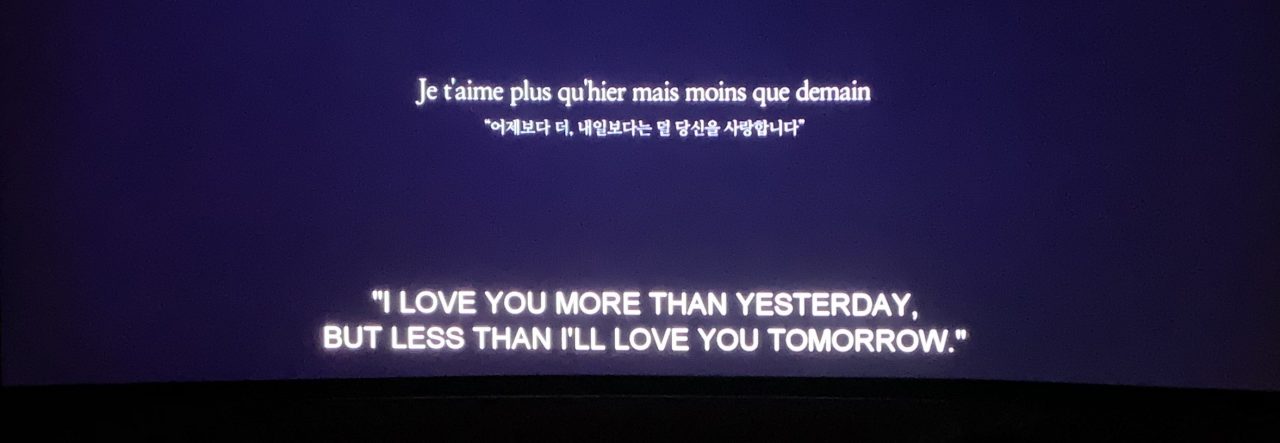
Our automatic response to someone saying “I love you” is “me too” or “I love you too.” But how can you say “too” if we love each other so differently? I would want to express to my lover that my love for them is fresh and so characteristically, so undoubtedly them. So I find that adding a “too” is a bit tacky. This sort of sounded better in my head, haha.

I’m a real sucker for that mutual understanding between two lovers that they love each other through actions. It kind of reminds me of that line from Troye Sivan’s song for him: “You don’t have to say ‘I love you’ to say I love you.”